
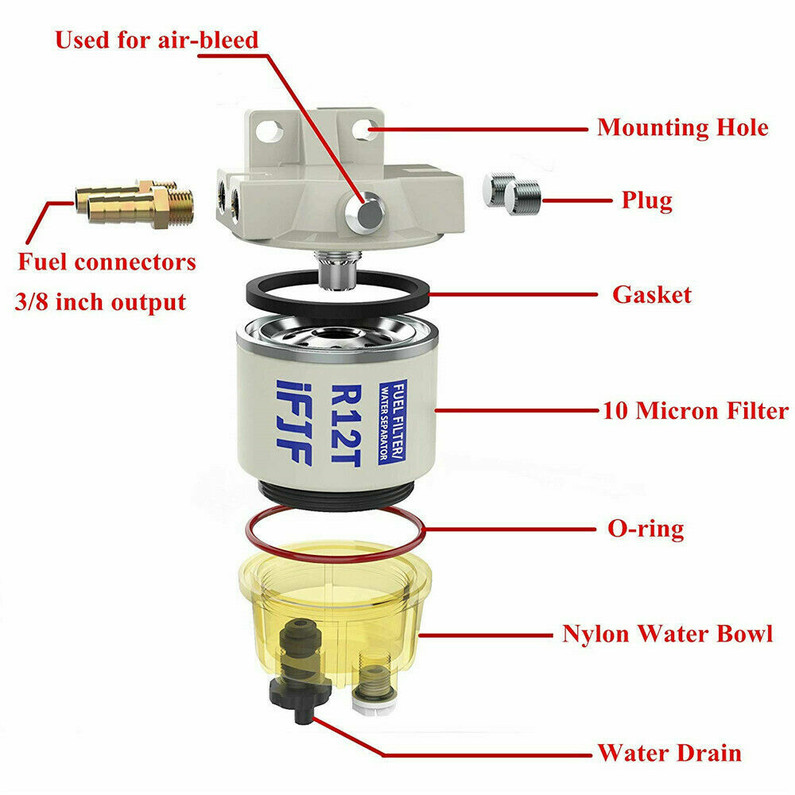
Fuel Water Separator Filters Explained
Fuel water separator filters remove water and debris from marine fuel systems. The correct micron rating and flow capacity protect the engine without restricting fuel delivery. Choosing the wrong filter can cause power loss, hard starting, or stalling.
Fuel contamination is one of the most common causes of outboard performance problems.
Water, debris, and degraded fuel can damage injectors, carburetors, and internal engine components. A fuel water separator filter is designed to remove these contaminants before they reach the engine.
This guide explains what micron ratings actually mean, the difference between 10 micron and 21 micron filters, why flow rate matters, and how to choose the right setup for your engine.
What a Micron Rating Actually Means
A micron rating tells you how small of a particle the filter can capture. The lower the number, the finer the filtration.
A micron is a unit of measurement equal to one millionth of a meter. In fuel filtration terms, it describes the size of particles the filter can trap.
A 10 micron filter captures smaller particles than a 21 micron filter. This includes fine debris that can damage sensitive fuel system components.
Finer filtration offers more protection but also increases resistance to fuel flow if the filter is undersized or clogged.
10 Micron vs 21 Micron, When Each Makes Sense
Ten micron filters provide finer filtration and are commonly used on modern fuel injected engines. Twenty one micron filters allow higher flow and are often used on older or carbureted systems.
Ten micron fuel water separator filters are designed to protect fuel injectors and high pressure fuel systems. They trap smaller contaminants that can cause injector damage or restriction.
Twenty one micron filters allow slightly larger particles to pass but reduce the risk of flow restriction. They are often used on carbureted engines or systems with higher fuel demand and lower sensitivity.
Choosing between them is not about which is better overall. It is about matching the filter to the engine and fuel system design.
Carbureted vs EFI, Two Stroke vs Four Stroke Considerations
EFI engines typically require finer filtration than carbureted engines. Fuel demand and system sensitivity vary by engine type.
Electronic fuel injection systems rely on precise fuel delivery and small injector passages. These systems benefit from finer filtration and cleaner fuel.
Carbureted engines are generally more tolerant of slightly larger particles but can still suffer from contamination related issues.
Two stroke and four stroke engines can both use fuel water separators. The key factor is fuel system design rather than engine cycle.
Always follow manufacturer guidance when available. Many modern outboards reference filtration requirements in service documentation.
Flow Rate, Why It Matters More Than People Think
Flow rate determines how much fuel can pass through the filter without restriction. A filter with insufficient flow capacity can starve the engine under load.
Fuel filters are rated for a maximum flow capacity, often measured in gallons per hour.
If the filter cannot supply enough fuel during acceleration or at wide open throttle, symptoms may appear even if the filter is clean.
These symptoms can include hesitation, loss of power, or engine shutdown at higher speeds.
Choosing a filter with adequate flow capacity for the engine’s fuel demand is just as important as choosing the correct micron rating.
Install and Replacement Tips, Gasket, Pre Fill, Air Pockets
Proper installation prevents air leaks and fuel restriction. Replacement intervals depend on usage and fuel quality.
When installing a new fuel water separator filter, inspect the gasket and lightly lubricate it with clean fuel or oil before installation.
Some systems benefit from pre filling the filter to reduce air in the fuel line. Others should remain dry depending on manufacturer recommendations.
After installation, ensure all fittings are tight and check for leaks. Air pockets in the system can cause hard starting or poor performance.
Most filters should be replaced at least once per season or more often in humid environments or high use conditions.
Symptoms of a Clogged Separator
A clogged fuel water separator can cause power loss, hesitation, stalling, or difficulty starting.
Common symptoms include reduced top speed, surging at higher RPM, hard starting, and engine shutdown under load.
Water accumulation inside the separator bowl or filter housing is another warning sign.
Replacing the filter early is far less expensive than repairing fuel system damage.
Frequently Asked Questions
Should I pre fill a fuel water separator filter
In some systems, pre filling can help reduce air in the fuel line. Always follow manufacturer recommendations for your specific setup.
Can a too fine filter cause power loss
Yes. If the micron rating is too fine for the system or the filter becomes clogged, fuel flow can be restricted and cause power loss.
How often should I change the separator
Most fuel water separator filters should be changed at least once per season or sooner if contamination is suspected.
Is 10 micron better for EFI
In most cases, yes. EFI systems typically benefit from finer filtration to protect injectors and fuel system components.
Why This Matters
Choosing the correct fuel water separator filter protects your engine while maintaining proper fuel flow.
This topic causes confusion because filtration involves tradeoffs. Clean fuel is critical, but restricting flow creates new problems.
Understanding micron ratings and flow capacity allows you to choose a filter that protects the engine without sacrificing performance.
Helpful Resources
Shop fuel water separator filters
Compare micron ratings and flow capacity
Contact our team for filter recommendations
Gregor’s Marine helps you choose the right filtration the first time.
Recent Posts
-
Parts Diagram Does Not Match My Mercury Outboard
If a Mercury parts diagram does not match what is physically on your engine, it usually means the se …Jan 31st 2026 -

Mercury Outboard Parts Lookup by Serial Number
The most accurate way to find the correct parts for a Mercury outboard is by using the engine’s seri …Jan 31st 2026 -
Marine Gear Lube Basics | SAE 90 vs 80W 90 for Lower Units
SAE 90 vs 80W 90 Marine Gear Lube SAE 90 and 80W 90 marine gear lubes can have similar viscosity at …Jan 31st 2026